Compass
Role: Leader, Researcher, UI Designer
While faculty-student mentorship relationships offer an array of psychosocial and career benefits to college students, student access to classic mentorship is often competitive and restrictive, as mentors have time and management constraints limiting the number of students a mentor can advise. One potential solution to address this problem is to mentor students remotely, which enables mentors to gain more flexibility in scheduling time. The affordances of digital technology also provide a space for interactions at scale.
However, the digital technologies currently being utilized for remote mentorship (e.g. email, group chat, video chat) are primarily designed for other types of social interactions and do not fully support all the interactions necessary for proper mentorship. The lack of technologies designed specifically for mentorship relationships limits the potential richness and usefulness of mentorship interactions mediated by online communication interfaces. While existing group chat interfaces and video chat applications seem to offer all the necessary components for online mentorship (i.e. they support real-time conversations for groups of individuals), their affordances quickly become strained as the number of people involved increases due to their linear conversational design models. A mentorship session with a large group of mentees communicating via these technologies would become chaotic and potentially unhelpful, as the number of mentees able to meaningfully engage in the session would be small and mentees would likely talk over each other in efforts to thoughtfully participate.
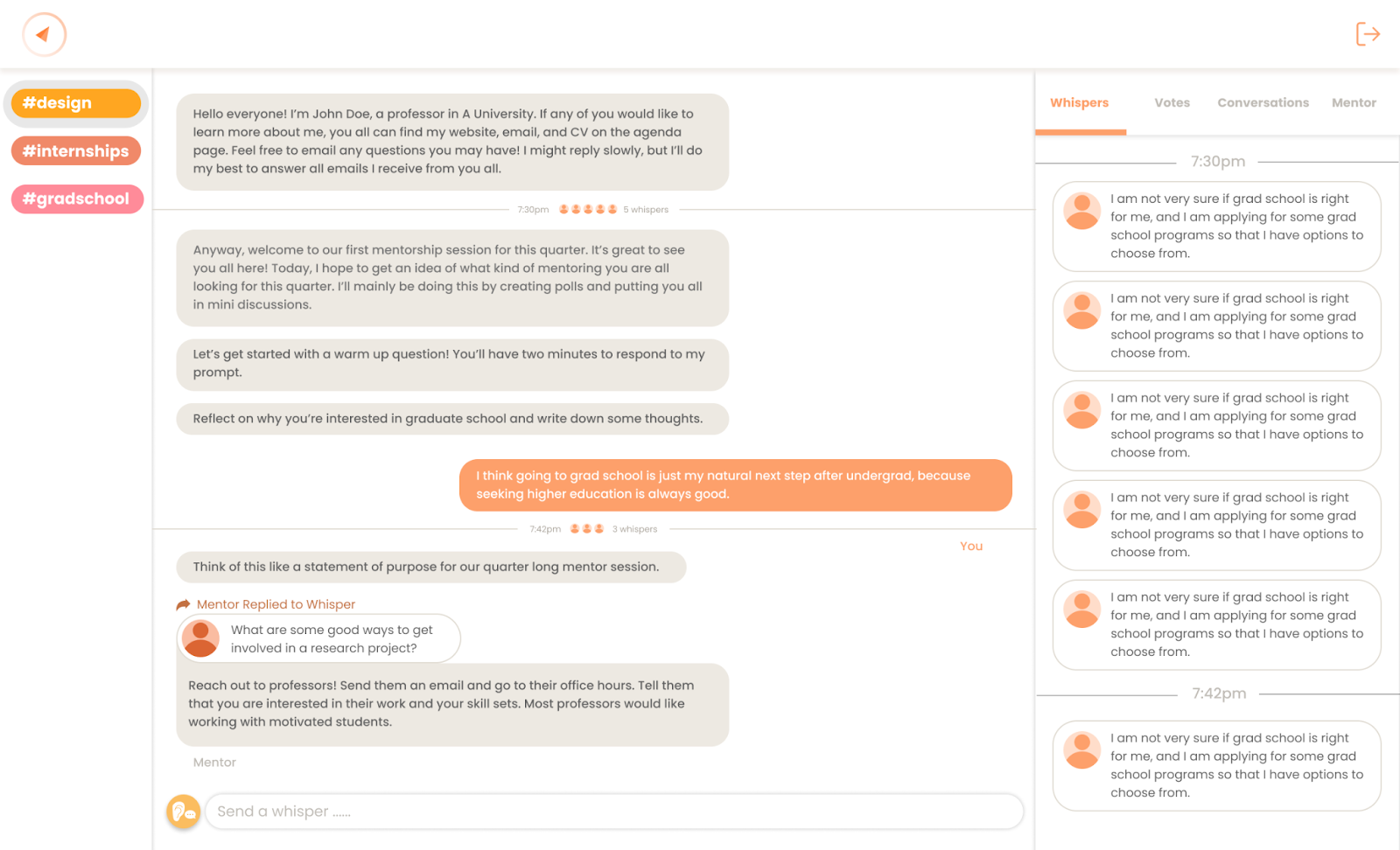
In order to support effective mentorship in large groups, we designed a new platform called Compass, where mentors can provide large-scale mentorship through novel multi-person chat-based conversational features that enable full engagement without the typical chaos of group chat. The reason why we choose chat-based interfaces is that it has a better performance on supporting both linear and nonlinear interactions than other mediums (e.g. video). However, the unstructured nature of conversations also brings the challenge that it is harder to orchestrate interactions at scale.