AI Painting
Role: Co-leader, UI designer
Painting, as one artistic form of expression, played an important role in the development of human cultures. Throughout the history of mankind, many different styles of painting have come into beings, such as Baroque, Impressionism, and Fauvism. In recent decades, artificial intelligence has received much attention. People commit to developing technologies that can enable computers to simulate human behaviors and activities. With the great progress made in natural language processing technology and computer image and visual processing technology, computers now have the ability to create visual art to some extent. At the time when I worked on this project, a great amount of research had been done on realistic image generation and style transfer. However, it was still an open problem of generating a painting that can meet the aesthetic rules in specific styles.
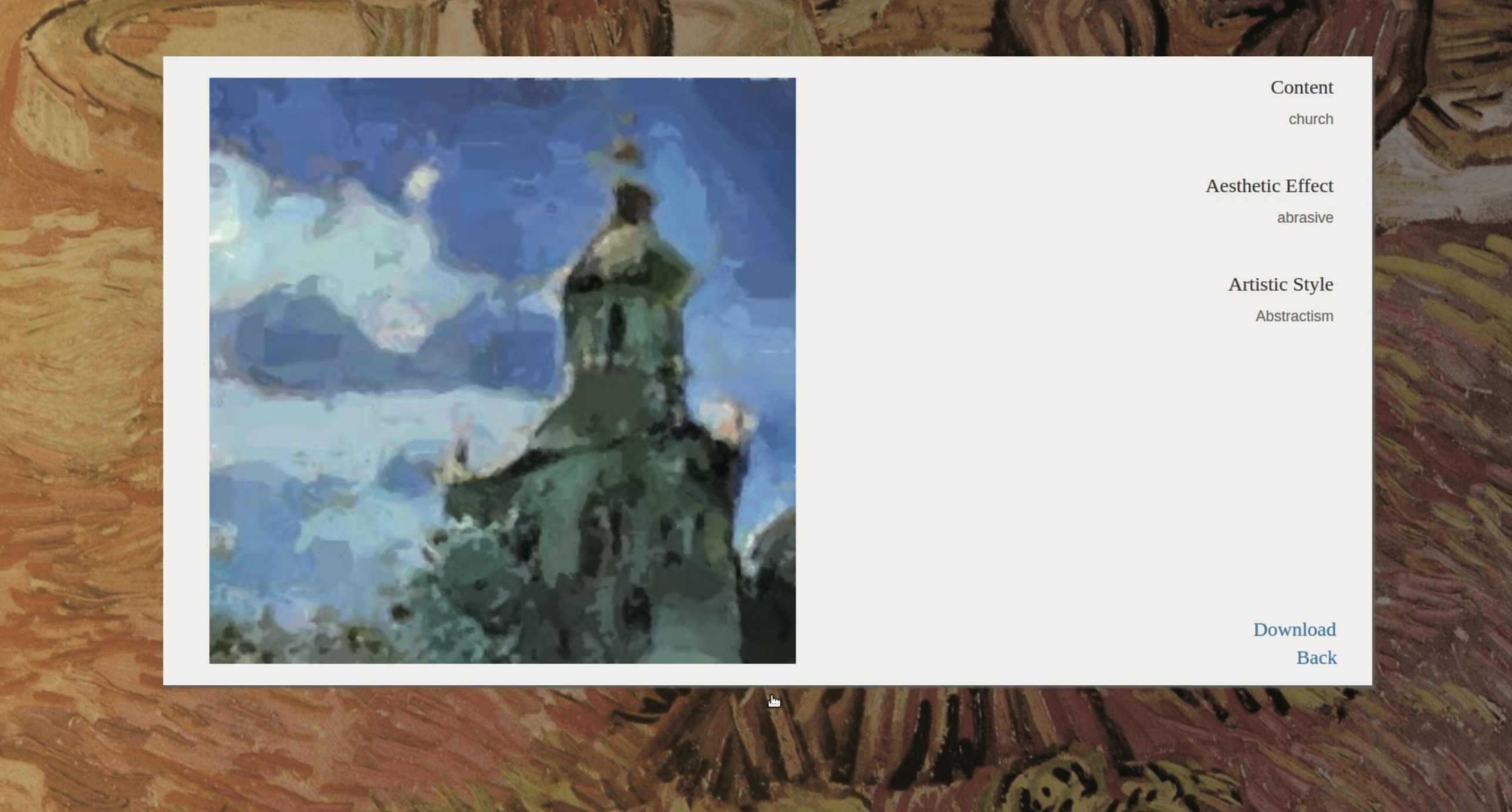
In this project, we were particularly interested in the following questions: Can a computer draw an impressionistic painting like a human? Can the painting meet people’s aesthetic expectations? As an attempt to address the questions, we built a system, AI Painting, which can generate a painting with a specific artistic genre based on users’ textual inputs. There are three parts of our system inputs, including the content of the painting (object or scene described by natural language), an aesthetic effect word (such as joyful, depressed), and an artistic genre. We provide six representative artistic genres for users to select, which are Impressionism, Neo-Impressionism, Post-Impressionism Abstractism, Suprematism, and Chinese Ink-Wash (Figure 1). After receiving the inputs, the system will illustrate the painting process via a short video to demonstrate how it paints a picture like a real artist. In the end, the users can download the finished painting.
Presented at: MM'18