A Disambiguity Framework for SVCD
Role: Leader
Smart Voice Controlled Device(SVCD) is prevalent all over the world. About 53 million people in the United States have at least one SVCD. The total number of devices in homes increases by 78 percent per year. Despite the growing popularity of SVCD, it still has many limitations. In this work, we focused on eliminating ambiguity in the commands, which has not been studied before. We presented two problems in ambiguity elimination. One is in multi-devices settings, where SVCD can not recognize which device the user wants to manipulate. The other one is in multi-users settings, where SVCD can not decide which command to executive among several commands from different users.
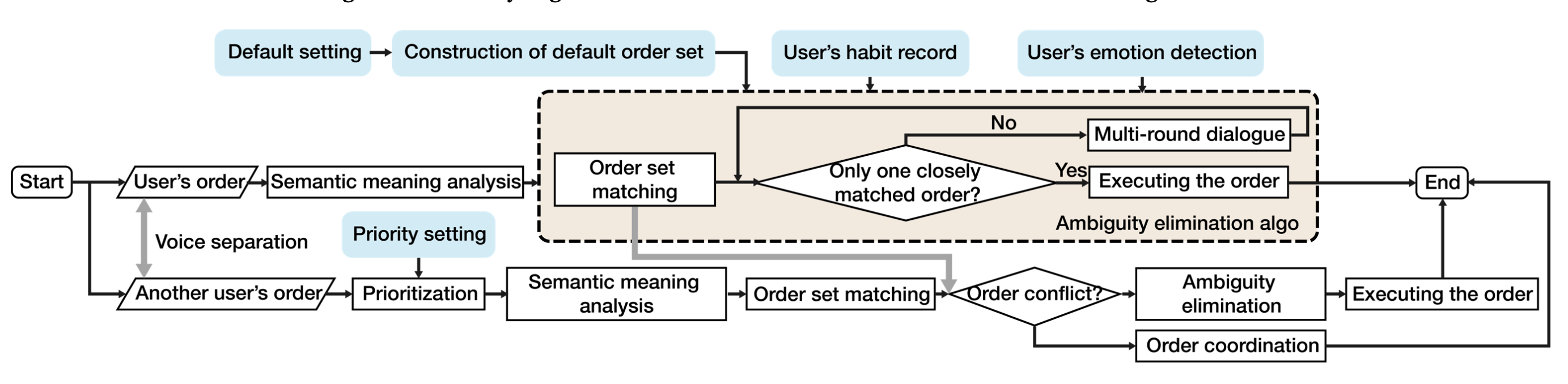
To address the problems, we propose a novel framework for SVCDs to eliminate ambiguity. To demonstrate our framework, we implement it in a virtual smart home system where the user can turn on or off the lights via a virtual SVCD. In our framework, the SVCD first uncouples the acoustic commands from different people. Then it eliminates the ambiguity in each user’s instruction with our algorithm. Next, our virtual SVCD will decide the priority based on the acoustic information and the level of ambiguity of their commands. If the device can decide the priority, it will execute an instruction or start a multi-round dialogue with the top priority user. Otherwise, the device guides the users to make a compromise. As for the algorithm, an SVCD possesses a depository storing abundant default instructions. The device calculates the semantic distance between the users’ commands and the default instructions. Based on the distance and the user’s emotions detected and recorded habit, the SVCD surmises the user’s intent. If ambiguity still exists, the device will embark on a multi-round dialogue with the user.
Presented at: IJCAI'19